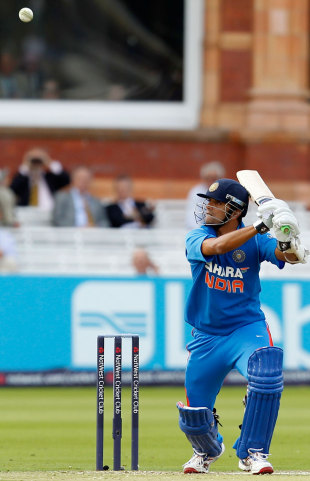
Many things have happened to Rahul Dravid on this England tour. He made his maiden century at Lord's, fulfilling a desire that was born the day he made 95 on Test debut at the ground 15 years ago. He opened for virtually the entire Test series barring the first innings of the first Test, and ended up with the Player of the Series trophy on the visitors' side. He walked in the second innings of the third Test at Edgbaston believing the umpire's word for a caught-behind when replays conclusively showed the ball had kissed an aglet on his left shoe-lace. He was shocked to hear the news that the he was part of the Indian one-day squad as reinforcement after injuries had ruled many of the frontline players. He played his first and last Twenty20 international where he hit three consecutive sixes, the most by an Indian in the match. Tomorrow Dravid will not only pull curtains on a "bittersweet" tour but also on his one-day career. Luckily Dravid does not mind that one bit.
Today Dravid was expansive, clear and even tinged his answers with a pinch of wit while facing the media on the eve of his final one-day match. Throughout his career Dravid's was an image of a man unsatisfied, of a man who despite all his achievements and humility, was struggling to prove something to himself, more than to the outside world. In some ways his battle with the self always benefited Indian cricket as he grew into the role of crisis manager. He climbed up the batting ladder to occupy a permanent position in the top order primarily at three and four where his best batting was seen.
Being a grafter at the first-class level, Dravid found life difficult in his formative years in the one-day game. But once he returned in 1999 having faced the axe a few times in his first three years, he transformed himself into a batsman who could pace an innings cleverly despite never going for the slog. He even led India, kept wickets, and moved up and down the order in search of pressure situations. He did everything that was asked of him and more. Today he explained how he could pull it off.
"I probably had to work harder in one-day cricket than in Tests. It has given me a lot satisfaction that I have been able to achieve so much," Dravid said. "When I started my career, obviously I wasn't recognised as much of a one-day cricketer, [I was] probably more in the traditional frame of mind. That's how I grew up playing cricket, that's how I played my Ranji Trophy cricket. So there was a lot more learning that I had to do in one-day cricket along the way. I faced some ups and downs, I got dropped in the middle, I had to go back and learn some lessons, I had to improve my game, keep getting better."
| 
|
But Dravid acknowledged the advantages of early struggle and the I-am-only-going-to-improve attitude. "It helped free up my Test game and it has given me lot of satisfaction," Dravid said of his one-day resurgence. "I have done a lot of different things for India in one-day cricket. In some ways that versatility, that ability to do different things helped me a lot. You open the batting, it is different; batting at three is different; keeping and then batting, batting and then keeping ... so many different situations that I found myself in. It helped me grow as a person and cricketer."
Currently Dravid is the seventh highest run-maker and eighth in the list of most ODI appearances, something even he didn't envisage when he started playing. "The fact that I played over 300 games, [and made] close to 11,000 runs gives me a lot of satisfaction. Maybe people might have said at some stage that I will have successful Test career, but I guess not many people would have said that I'll play that many one-dayers at the start of my career. I wouldn't have said that about myself."
Though he did not shortlist his best one-day innings, Dravid pointed out reaching the final of the 2003 World Cup as one of the highlights of his career. Equally satisfying, he said, was watching MS Dhoni's side win the World Cup earlier this year even if Dravid was not part of the squad. "As a young kid in 1983, watching Kapil Dev lift the World Cup was a huge inspiration for me as a 10-year-old. Towards the end of my career, watching another Indian team and being part of the journey in some ways, and watching a team led by Dhoni in 2011 has been really satisfying," Dravid said. The biggest disappointment for him would be the failure to make the Super Sixes in the 2007 World Cup where India lost to Bangladesh in the league stage. He was the captain, and has still not come to terms with that disappointment.
The intensity in their training, the discipline, the hardwork have been the pillars on which Sachin Tendulkar, Anil Kumble and Dravid built their success. These were also the characteristics that aided in the trio's longevity. "If you want to play international cricket and international sport for a long period of time, there are certain sacrifices that you need to make and discipline that you need to follow," Dravid said. "To be honest I have never seen them as sacrifices. I love the lifestyle of a cricketer, I love being a cricketer, l liked playing for my country. In some ways I feel lucky that I enjoy hitting the balls in the nets, I enjoy working hard and I enjoy practising. Sometimes when people ask me 'what will you do after cricket', I feel I will miss just that intensity of preparation, the practice."
In the last two months Dravid has always been the first player to come out an hour or two before the rest of the Indian squad assembled for training. Today was no different. He was at SWALEC stadium, facing throw-downs from Trevor Penney, the Indian fielding coach. It was a beautiful sunny day, and the trees surrounding the small ground dazzled in the vintage autumn colours of red, gold and orange. Comfortable in his own space, Dravid set about working on minor adjustments to his batting technique. It does not matter to him that he won't have to play another ODI after tomorrow.
"I am not dreading quitting. You just recognise that the time has got to come at some stage when you have got to move on. I am happy and I am comfortable in the space that I am in. I am happy with the way my career has progressed, how it has progressed in both forms of the game."
 Born: August 26, 1910
